"Will AI take my job?" is probably the most common worry about AI today. The short answer: AI changes tasks more than it eliminates jobs. People who work with AI are likely to replace people who don't.
What do the numbers say?
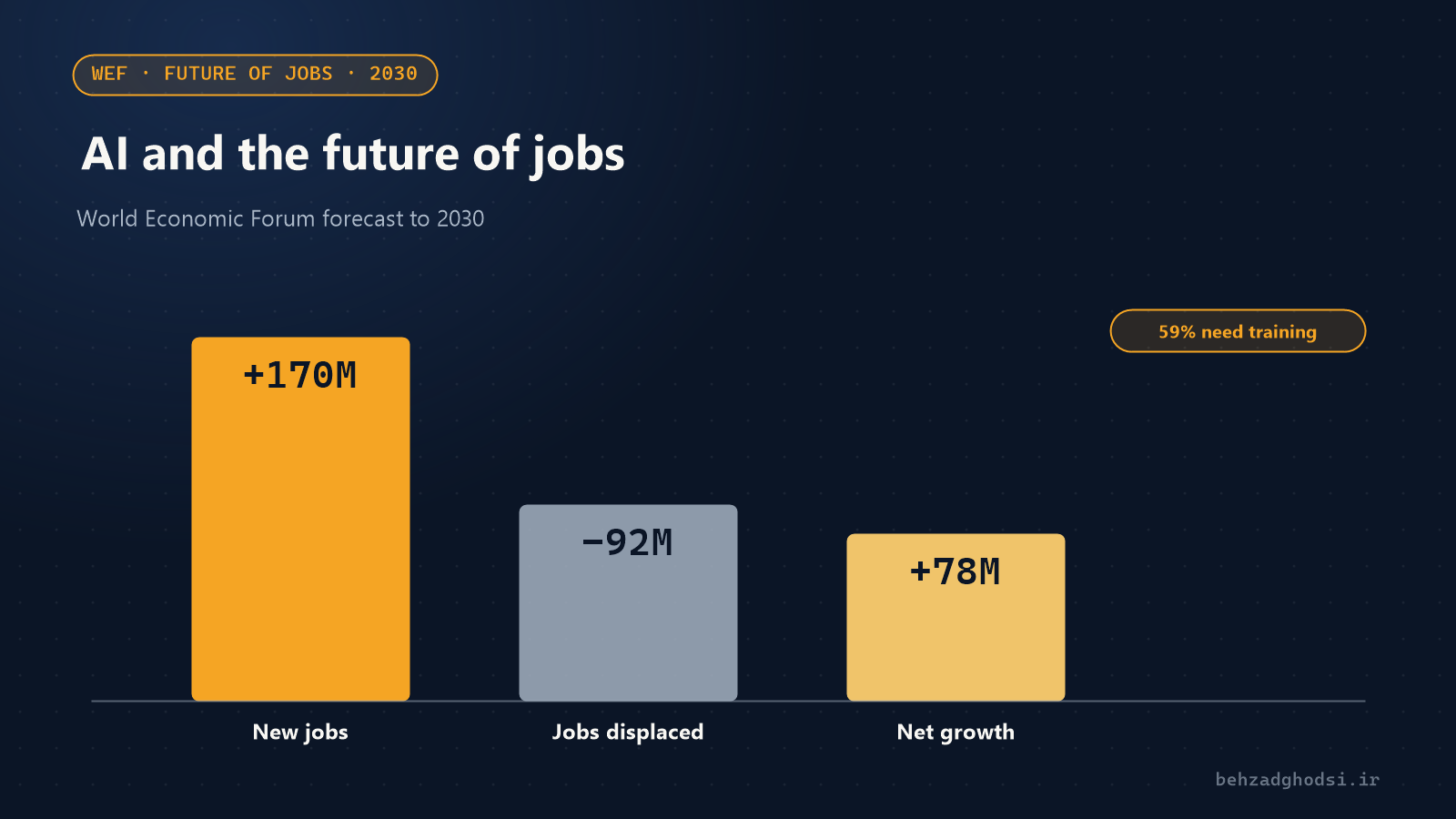
The World Economic Forum's *Future of Jobs Report 2025*, based on more than 1,000 large employers with over 14 million workers in 55 economies, forecasts the following by 2030:
- About 170 million new jobs will be created.
- About 92 million jobs will be displaced.
- That means a net gain of about 78 million jobs.
- About 59% of the global workforce will need reskilling or upskilling by 2030.
Which work is most exposed?
Work that is repetitive, rule-based and desk-bound is most at risk. In the WEF report, these are among the fastest-declining roles:
- Data entry clerks and administrative assistants
- Cashiers and ticket clerks
- Accounting and bookkeeping clerks
Beyond these, tasks such as simple phone support and repetitive content production are changing quickly with chatbots and agents.
Which jobs are growing?
- Data, AI and machine learning specialists
- Information and network security: every new intelligent system is a new target for attack.
- Fintech and software engineers
- Human and care work: nursing, teaching and counselling
- Hands-on technical work: electricians, technicians and equipment installers, whom AI won't replace any time soon
Six practical steps to prepare
- Start working with AI today. Pick one of your repetitive tasks and see how ChatGPT or Claude can speed it up. The free AI guide is a good place to start.
- Invest in judgement and communication. Problem solving, negotiation, leadership and understanding customers are hard to automate.
- Learn data literacy. Reading reports and charts and working with spreadsheets and dashboards is valuable in any job.
- Have basic technical skills. Even basic knowledge of networking, security and automation puts you ahead.
- Automate repetitive tasks and spend your time on higher-value work.
- Keep learning. Technology changes every year; the most important skill is the ability to learn new ones.
For employers
Don't see AI as a way to cut staff; see it as a way to remove repetitive work and give the same people higher-value tasks. Companies that train their staff get the most out of AI. To automate your company's processes, see the AI agent development service.