The phone rings. It's your child's voice, crying: "I've had an accident, I need money right now, don't tell anyone." The voice is exactly theirs. But it might not be them.
Voice cloning has become one of the fastest-growing scams in recent years. The US Federal Trade Commission (FTC) has been warning about it for several years, and as AI tools get cheaper, it is spreading everywhere.
How does the scam work?
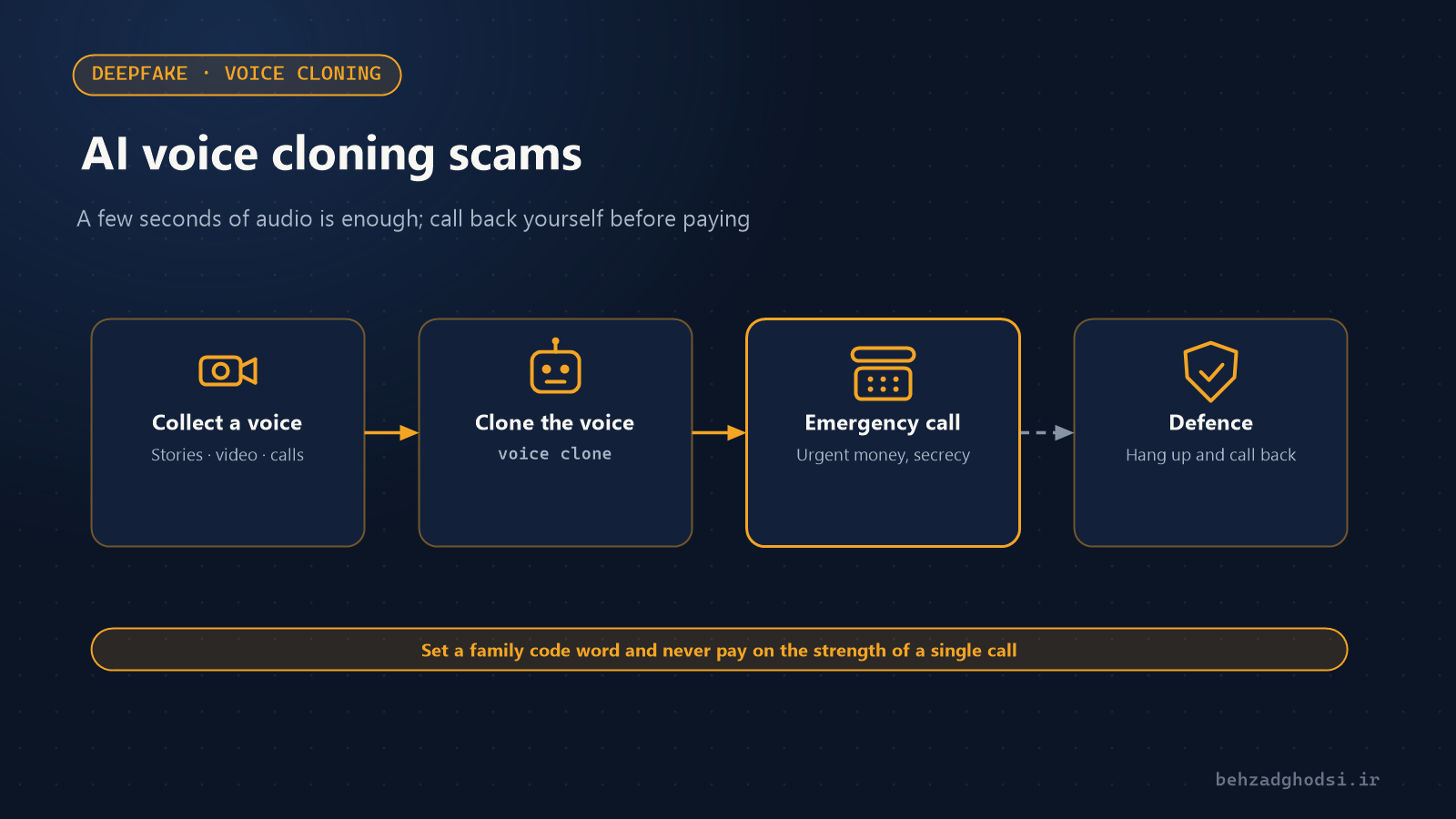
- Collecting a voice: a few seconds of someone's voice is enough, from an Instagram video, a story, a voice message or even a short call answered with "Hello?".
- Cloning the voice: AI tools create a voice that can say any sentence in that person's tone.
- The emergency call: the scammer uses the voice to call family, friends or colleagues with an urgent story asking for money or information: an accident, an arrest, a kidnapping, or "the CEO needs a transfer right now".
The same trick works with deepfake video: a video call with the fake face and voice of a manager or family member.
Signs of a fake call
- Extreme urgency: "right now", "there's no time".
- A request for secrecy: "don't tell Dad", "don't tell anyone".
- Unusual payment methods: transfers to an unknown account, cryptocurrency or gift cards.
- An unknown or hidden number, or an excuse like "my phone broke, I'm calling from a friend's".
- Avoiding personal questions or changing the subject.
- In video: unnatural lip and eyelid movement, blurring around the face and a lag between sound and picture.
Seven ways to protect yourself
- Set a family code word. A word only family members know, asked in an emergency.
- Hang up and call back. End the call and phone the person on their usual number.
- Ask a personal question whose answer can't be found on social media.
- Don't rush. No real emergency gets worse because you took a few minutes to verify.
- Limit your public voice and video. Make personal profiles private, especially for children and older relatives.
- Teach older family members. They are the main targets of this scam.
- Set a two-channel rule at work: no payment or bank-detail change is ever made on the strength of a single call or message; always confirm through a second channel.
If you have been scammed
- Call your bank immediately so the transaction can be traced or blocked.
- Report it to your police cybercrime unit.
- Warn the people around you, as the scammer may target them too.
AI scams are just one of the risks of this technology. To keep your information out of scammers' hands, also read the guide to privacy in chatbots.
Source: Federal Trade Commission (FTC) ↗