The Japan Aerospace Exploration Agency (JAXA) launched the MMX spacecraft on 20 October 2026 at 04:41 Japan time on an H3 rocket from the Tanegashima Space Center. JAXA says the spacecraft is on its planned trajectory.
The mission
MMX is set to do three things for the first time:
- Orbit Phobos, the larger of Mars’s two moons.
- Collect samples from the surface of Phobos, with a target of at least 10 grams.
- Return to Earth from the Mars system.
The spacecraft carries two sampling tools: a corer that takes material from a few centimetres below the surface, and a sampler that uses pressurised gas to collect surface material.
Timeline
According to the plan, MMX reaches Mars in summer 2027, studies Phobos and Mars’s other moon, Deimos, up close, and the sample capsule lands in Australia in 2031.
Why it matters
Scientists still do not know whether Phobos is an asteroid captured by Mars or a piece of Mars itself, thrown off by a large impact. Real samples could settle the question.
The mission is led by Japan with NASA, the European Space Agency (ESA), France’s CNES and Germany’s DLR. ESA provides communication equipment and ground stations for sending commands and receiving data.
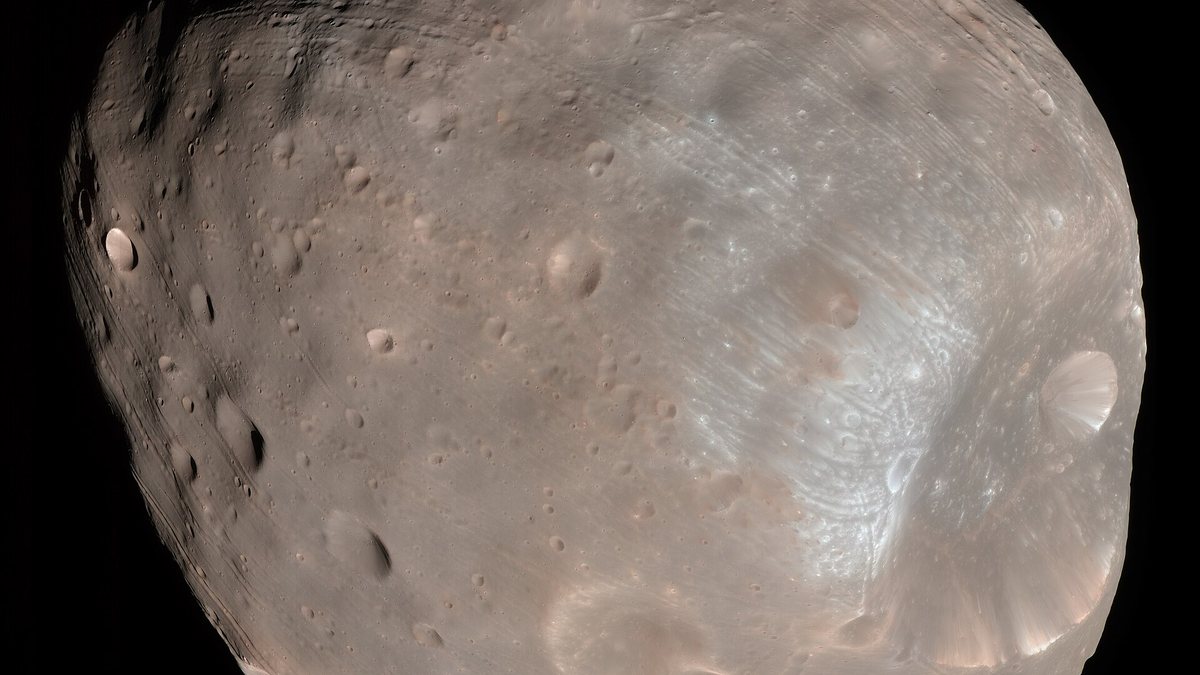
Photo: Phobos seen by the HiRISE camera on NASA’s Mars Reconnaissance Orbiter (2008); NASA / JPL-Caltech / University of Arizona, public domain, via Wikimedia Commons; cropped.
Source: European Space Agency (ESA) ↗