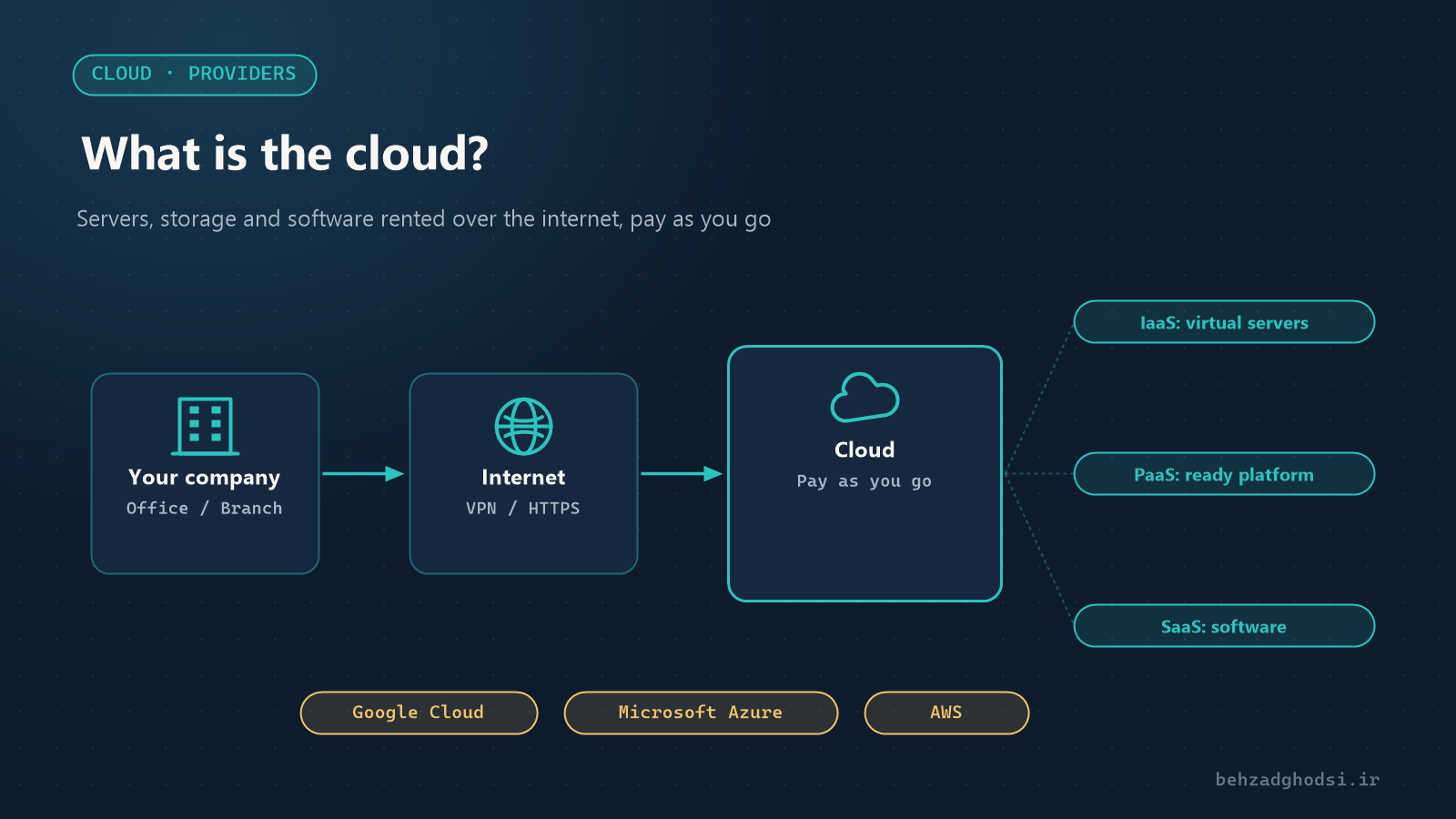
The cloud, or cloud computing, means that instead of buying a server, keeping it in a server room and paying for its power, cooling and maintenance yourself, you rent the same resources over the internet and only pay for what you use. The servers sit in the provider’s data centres and you connect to them from anywhere.
What problems does the cloud solve?
- Up-front cost: there is no need for a big one-off investment in servers and equipment.
- Scalability: if tomorrow you need twice the resources, they are added in minutes, and you scale back down when you do not.
- Access from anywhere: head office, branches and remote staff all connect to one shared service.
- Resilience: large data centres have backup power, internet links and hardware, which is expensive for a small company to provide.
The three main service models
- IaaS (infrastructure as a service): you rent virtual machines, networking and storage; the operating system and software are yours to manage. Example: a Windows or Linux virtual server.
- PaaS (platform as a service): you get a ready environment for running applications and do not deal with the operating system or its updates. Example: a managed database.
- SaaS (software as a service): you use the software itself in the browser. Examples: Microsoft 365 and Google Workspace.
There are also three deployment models: the public cloud (the provider’s shared resources), the private cloud (dedicated infrastructure for one organisation, usually with virtualization on your own servers), and the hybrid cloud, where some services stay in-house and some move to the public cloud.
The world’s leading cloud providers
1. Amazon Web Services (AWS)
AWS is the oldest and largest cloud provider, with around a third of the global cloud infrastructure market. It offers more than 200 services, from virtual machines (EC2) and storage (S3) to databases and AI. Its strengths are the range of services and global coverage; its weakness is complex pricing.
2. Microsoft Azure
Azure is the second-largest provider and the natural choice for organisations using Windows Server, Active Directory and Microsoft 365, because it integrates with the same tools and makes hybrid cloud simpler.
3. Google Cloud
Google Cloud is the third major player and is strong in data analytics, AI and Kubernetes (which Google itself created). It is popular with software teams and data-driven projects.
4. Alibaba Cloud
The largest cloud provider in China and one of the main players in Asia. It matters for businesses working with East Asian markets.
5. Oracle Cloud and IBM Cloud
Oracle Cloud suits organisations that run Oracle databases, and IBM Cloud focuses on hybrid cloud and large industries.
Smaller providers
For small projects, a simple virtual server from companies such as Hetzner and DigitalOcean is cheaper and simpler. Local providers in many countries also offer cloud servers billed in local currency and hosted in local data centres, which can be more practical for local services and data residency rules.
Which one should you choose?
- If your infrastructure is Microsoft-based: Azure.
- If range of services and global coverage matter most: AWS.
- If your main work is data and AI: Google Cloud.
- If you only need one or a few simple virtual servers: smaller or local providers.
Payment methods, data residency and legal requirements are also part of the decision; check them before you move any services.
Should everything move to the cloud?
No. The cloud is excellent for variable workloads, services that must be reachable from anywhere and off-site backups. But for steady, heavy workloads, in-house servers may be cheaper in the long run. Many organisations work in a hybrid way: core services on their own servers, backups or public-facing services in the cloud.
Do not forget three things:
- Watch the cost: resources left running cost money even when unused. Set up cost alerts.
- Security is your job: the provider protects the data centre, but access settings, passwords and the firewall are your responsibility.
- Connect securely: link your internal network to the cloud over VPN, not by opening ports on the internet.
The cloud means renting computing resources as you need them. AWS, Azure and Google Cloud are the three main global players, each strongest in its own area. The right choice depends on your current infrastructure, the type of workload and your budget.