An IP address does for network devices what a postcode does for houses: without it, packets don't know where to go. Subnetting is the part of Network+ people fear most, but with one small table it becomes simple.
What is an IPv4 address made of?
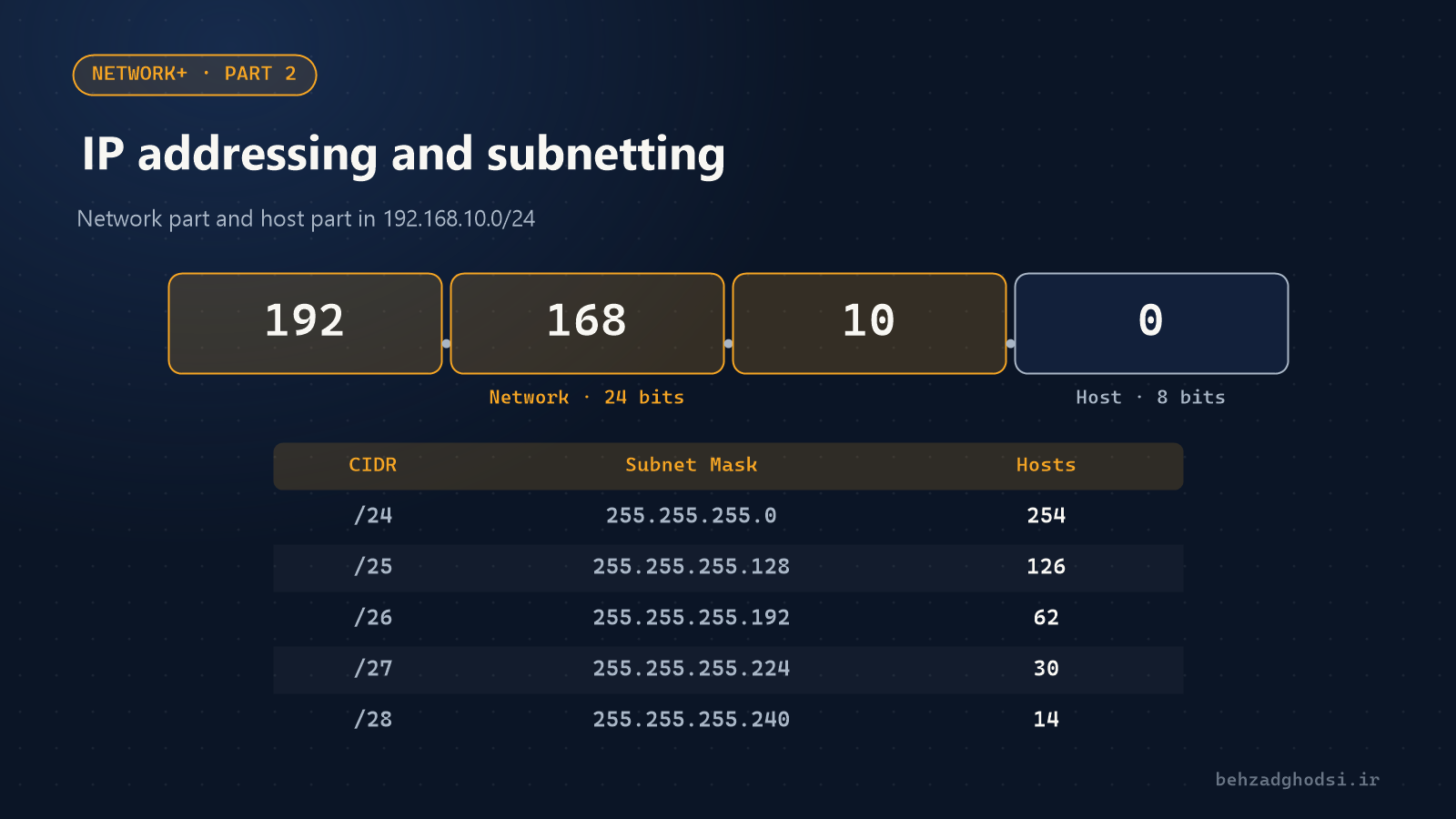
An IPv4 address is 32 bits, written as four numbers from 0 to 255, such as 192.168.10.25. Every address has two parts:
- Network part: shows which network the device is on.
- Host part: identifies the device itself within that network.
The subnet mask sets the boundary between the two. A mask of 255.255.255.0 means the first 24 bits belong to the network, which is why it is written in short form as /24 (CIDR notation).
Gateway and DNS
- Default gateway: the router address you hand packets to when their destination is outside the network. If it is wrong, the local network works but the internet doesn't.
- DNS: the server that turns names into IPs (explained fully in part 5).
Private and public IPs
These three ranges are reserved for internal networks and are not routed on the internet:
| Range | Default mask | Typical use |
|---|---|---|
| 10.0.0.0 to 10.255.255.255 | /8 | Large organisations |
| 172.16.0.0 to 172.31.255.255 | /12 | Medium networks |
| 192.168.0.0 to 192.168.255.255 | /16 | Home and small office |
Two other special addresses you will see often:
127.0.0.1, or loopback: the device itself.169.254.x.x, or APIPA: the computer didn't get an address from DHCP and made one up. If you see this, the problem is DHCP or the cable, not the internet.
IP classes: only for the exam
Addresses used to be divided into class A (up to 126), B (128 to 191) and C (192 to 223). Today, with CIDR, any mask is possible, and classes survive only in exam questions and old terminology.
Subnetting with one table
Subnetting means dividing one large network into several smaller ones, for example a separate network for each floor or department. This table answers almost every question:
| CIDR | Mask | Addresses | Usable hosts |
|---|---|---|---|
| /24 | 255.255.255.0 | 256 | 254 |
| /25 | 255.255.255.128 | 128 | 126 |
| /26 | 255.255.255.192 | 64 | 62 |
| /27 | 255.255.255.224 | 32 | 30 |
| /28 | 255.255.255.240 | 16 | 14 |
| /29 | 255.255.255.248 | 8 | 6 |
| /30 | 255.255.255.252 | 4 | 2 |
The simple rule: each bit added to the mask halves the number of addresses. Subtract two addresses from each subnet: the first is the network address and the last is the broadcast address.
A real example
We want to split 192.168.10.0/24 into four parts for admin, finance, cameras and phones. Four parts means two more bits, so /26 with 64 addresses each:
| Department | Network | Host range | Broadcast |
|---|---|---|---|
| Admin | 192.168.10.0/26 | .1 to .62 | .63 |
| Finance | 192.168.10.64/26 | .65 to .126 | .127 |
| Cameras | 192.168.10.128/26 | .129 to .190 | .191 |
| Phones | 192.168.10.192/26 | .193 to .254 | .255 |
Practical tip: always leave room to grow. If you have 50 cameras now, a /26 fits up to 62; if you'll have 80 by the end of the year, take a /25 from the start.
IPv6 at a glance
IPv6 is 128 bits and written in hex, such as 2001:db8::1. It is still rarely used in many internal networks, but Network+ asks about a few points: there is no broadcast, fe80:: addresses are link-local and ::1 is the loopback.